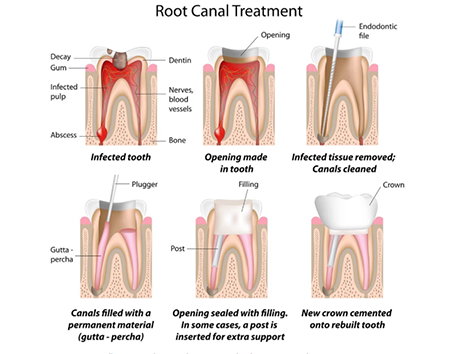
A badly infected or damaged tooth will require Root Canal Therapy (RCT) if the patient wishes to save the tooth. The tooth may have become infected due to decay, trauma, repeated dental work, wear and tear, gum disease, cracked fillings or a broken tooth that exposes the nerve. When the nerve of the tooth is dying it releases bacteria inside the tooth, this can create pain and pressure which is the result of an infection and abscess. Although we have many advances in dental technology to replace lost teeth, it is important to save your natural teeth wherever possible. Root Canal Therapy is an excellent option to save your natural tooth.
Generally there are three main stages of root canal therapy. 1) Emergency treatment
Once the rubber dam has been placed, the tooth is opened by preparing a small access cavity into the top of the tooth’s biting surface. The aim of this is to remove the bulk of the infection from the canals inside the tooth root, and relieve your pain/toothache. It is also a good opportunity for the dentist to remove all decay, and check the condition of the tooth and remaining tooth structure to ensure a good prognosis for treatment. If the dentist deems the tooth to have a poor/hopeless long term prognosis, a root canal may not be suitable and other options can then be explored.
In most cases the tooth does have a good prognosis. Once this is confirmed the canals will be rinsed, dried, and a medication placed. The medication consists of an antibiotic, anti-inflammatory, and a corticosteroid. A temporary filling is placed and the tooth is now ready for the next stage of treatment, which can start in as little as two weeks time.
2) Preparation (Chemomechanical Preparation)
During this procedure the tooth is measured internally from the top of the tooth to the tip of each root. This measurement is recorded as the working length. Each canal inside the tooth is cleaned and shaped thoroughly to this confirmed working length. Once the canals have been cleaned thoroughly and shaped perfectly, they are rinsed and dried. From this stage another medication is placed and the tooth again sealed for a minimum of 2 weeks.
3) Completed / Sealed (Obturation)
This is the final procedure of a root canal. The tooth/canals are opened again and the tooth is rinsed, and the shape is checked. Providing the tooth canals are clean and symptom free – we can complete the root canal therapy. A rubber point called a Gutta Percha (GP) will be used to seal the root canal with the aid of a root canal sealer. This therapy will be confined to the internal canal of your tooth and does not communicate with any other oral structures. Once the treatment is complete, crown placement is imperative to ensure the longevity of the tooth. For more information on crowns see our next heading.
Why do we crown teeth after
Root Canal Therapy (RCT)?
No, the therapy itself is not painful. If you present to Admire Dentistry with a toothache and it is diagnosed as needing root canal therapy, we do an initial drainage of the dying nerve. This releases the pressure from the bacteria within the tooth and alleviates pain. From here, root canal therapy is painless, but we will always give you local anaesthetic.
Yes, you should always do everything possible to save your natural tooth. Although there are many options out there to replace teeth, nothing is better than your natural tooth. When your tooth is infected or damaged due to decay, trauma, repeated dental work, wear and tear, gum disease, cracked fillings, or a broken tooth that exposes the nerve, root canal therapy is a good option to save the tooth. Our practitioners at Admire Dentistry will always give you all the information you need to make the best decision for you
Root canal therapy is a very involved procedure completed only by skilled and competent dentists and specialists. It is important to know that root canal therapy is an excellent choice to save your own tooth, with a success rate between 86%-93%. If by chance a root canal therapy fails and you are a good candidate for re-treatment, you will be referred to an Endodontist for retreatment. A root canal therapy retreatment has an excellent success rate of around 73%.
For the best chance of success after a root canal, the tooth must be crowned. Crowns typically last 7-10 years. However, poor oral health habits can cause failure much earlier. Alternatively, excellent oral health habits have seen these procedures outlast the recommended times by years. Some root canal treatments and crowned teeth have lasted people 30+ years.
The number of visits may vary depending on the tooth’s complexity, the extent of the infection, and specific patient needs. At Admire Dentistry, we take the time to ensure the best treatment possible. Typically, 3 appointments are required for root canal therapy. 1) emergency pain relief, access, and tooth structure assessment. 2) CMP (chemo-mechanical prep) – cleaning and shaping the root canal. 3) Obturation: final cleaning and sealing of the root canal. After the root canal, a final core filling and crown will need to be placed to ensure long-term success. This is completed over two appointments, 1) core and crown preparation. 2) insert of crown.
Pain absence doesn’t mean the tooth is healthy. Leaving an infected tooth untreated can lead to more severe infections, abscesses, and potential health complications. Our dentists at Admire Dentistry can evaluate your tooth condition and recommend appropriate treatment, which might not always include root canal therapy.
Root canal treatments are a routine and safe procedure performed to save damaged or infected teeth. Some patients might experience:
Temporary tenderness or slight discomfort around the treated tooth after the procedure but will usually subside in a few days.
Minimal swelling around the treated area. This will resolve once the initial infection settles.
These are normal post-treatment responses and are not alarming. It’s always important to follow your dentist’s aftercare recommendations and to reach out as soon as possible when concerned. With proper care, the vast majority of root canal treatments are successful and trouble-free.
The initial recovery period after a root canal is typically short, with most patients resuming normal activities within hours. While the treated tooth and surrounding area might have some sensitivity or mild discomfort, these usually subside within a few days to a week. Over-the-counter pain relievers can help manage any discomfort. It’s essential to avoid chewing with the treated tooth until it’s fully restored with a crown to prevent damage to the tooth.