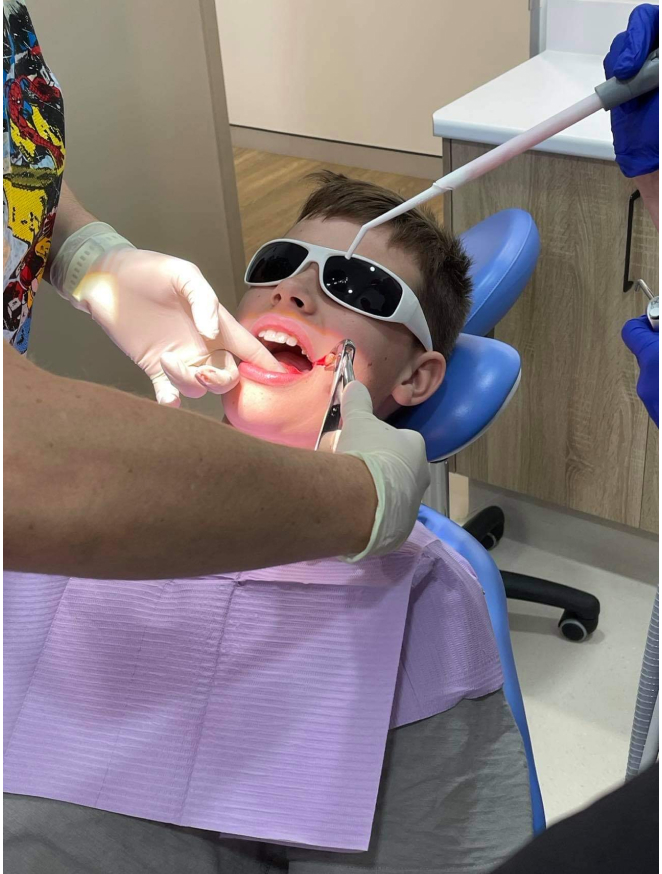
Although we try to educate our patients on the importance of saving your natural teeth, sometimes the removal of a tooth is unavoidable. Admire Dentistry understands that the thought of removing a tooth can be daunting. Our team of dentists are very experienced, give clear explanations with pre and post-operative instructions, and always offer a hand to hold. An initial consultation appointment will be required. At this appointment our dentists will take radiographs, complete the diagnosis, and create a thorough treatment plan tailored to your individual treatment needs.
If the tooth removal is very complicated, or you would prefer to have your tooth removed while you are sedated or asleep, you will need to be referred to an oral surgeon. At your consultation appointment with us we will help with the planning and complete the referral on your behalf.
Admire Dentistry offers in chair tooth removal under local anaesthetic (The Wand), and we provide Happy Gas (Nitrous Oxide) sedation or oral sedation (Diazepam) if necessary.
Situations that may require the removal of a tooth include:
Crowded teeth where the Orthodontist has no other option but to advised removal before braces are placed
Nerve infection where the option for removal has been chosen over Root Canal Therapy
A heavily decayed or broken down tooth where restoration is not possible
Root fracture below the gum and bone level where restoration is not possible
Financial reasons where removal is more affordable than restoration
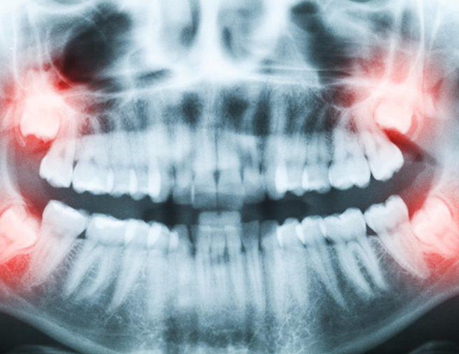
Wisdom Teeth that become stuck if there is not enough space to grow properly
Wisdom Tooth Removal
Wisdom teeth are the last of your adult teeth to erupt, this most commonly happens in your late teens or early twenties. Sometimes they cause pain as they push through, which is normal, and once they are all the way through the pain dissipates. However, if there is not enough room in your mouth, or if they get stuck at an angle, they will require removal.
Not all wisdom teeth that require removal cause pain. Sometimes patients don’t even know they have wisdom teeth until their dentist takes a whole mouth radiograph, known as an orthopantomogram (OPG). OPG’s are vital in the early diagnosis of wisdom tooth problems. A wisdom tooth can be stuck in the bone, gum, or behind another tooth. This poor positioning can make the tooth difficult to clean around and become a food trap, which greatly increases the chance of infection. While you are fit and healthy, and your body has a strong immune system, this might not ever cause you a problem. Any minor infection or irritation that occurs would be quickly dealt with by your strong immune system, and you usually don’t even know you’ve had a problem. However as you age, or if you get run down and unwell, your body is no longer able to cope with this minor infection, and you get a flare up. This is usually an acute, localised infection with intense pain. At this point you will require strong antibiotics and an emergency dental visit or a trip to the oral surgeon. This intense pain and infection could have been easily avoided by following the advice of your dental practitioner and having the ill positioned wisdom tooth removed before pain and infection occurred.
Another unfavourable result of neglecting an ill positioned wisdom tooth is when it is stuck behind its neighbour. In this situation it is common for food to get in and wedge between the two teeth, which can cause decay. Unfortunately many times the patient not only needs the wisdom tooth removed, but also removal of the tooth beside it. Again, something that could have easily been avoided.
It is important to see your dentist to ensure early diagnosis if there is a problem starting. Your dentist can help you identify if wisdom tooth removal is necessary. Our dentists at Admire Dentistry are experienced in wisdom tooth removal and are here to guide you through this process. If the extraction is particularly complicated we work closely with Oral Surgeons to offer you additional options for treatment, including sedation or general anaesthesia – as discussed above.
Alternatively, if your wisdom teeth push through completely, fit well in your mouth, maintain function, and you are able to clean them well – there is no reason for removal. Your dentist will simply check these teeth along with all your other teeth at your routine dental exam and clean.
This depends on the difficulty and complexity of the extraction. If simple, some people are back to normal within days. If complicated, it can take 1-2 weeks until you feel back to normal again. Closure of the tooth removal site is typically 1-4 weeks, while complete healing of the bone can take 8-12 weeks. Many factors come into play, and it’s best to seek advice from your dental professional. Tooth extraction is not always as terrible as Google makes it out to be.
Many factors come into play when anticipating the recovery and pain from a tooth extraction, so it is best to seek advice from your dental professional. Tooth extraction is not always as terrible as Google makes it out to be. With Admire Dentistry’s pain-free technology, tooth extractions are often followed by minimal discomfort. Prescribed or over-the-counter pain relievers effectively manage any post-procedure sensations. We prioritise your comfort, ensuring a smooth, largely pain-free recovery.
The surgical extraction won’t hurt since local anaesthetic will be given. After the anaesthetic wears off, you might feel some discomfort and swelling around your cheek and gum. If you are really nervous or the extraction looks complex, our dentists will always refer you to an oral maxillofacial surgeon. This allows you to have your wisdom teeth removed under general anaesthetic, ensuring you are asleep for the whole procedure.
While light activities can be resumed, strenuous exercise or heavy lifting should be avoided for 24 hours, as well as consuming hot or hard foods and touching the extraction site. For at least 72 hours, you must avoid vigorous rinsing or spitting, drinking through straws, smoking or tobacco use, and consuming alcohol. While you are healing, we rely on the blood clot to insulate the socket until the gum closes. The above activities can cause blood clot loss which can lead to a dry socket. Dry sockets are extremely painful.
Yes, if the tooth falls off on its own, we’ll conduct a check-up to see whether any trauma has occurred. If an adult tooth has fallen out from trauma in an adult or child, keep the tooth clean or gently rinse it, but do not touch or scrub it. If possible, place it back into the tooth socket, or keep it in sterile saline or milk and present it immediately to your dental practitioner. If there has been no trauma and you’re an adult who has lost an adult tooth, and other teeth are loose. This is a sign of a larger, more serious problem relating to gum disease; please present it to our team at Admire Dentistry ASAP.